Sunday, December 13, 2015

Hidden Messages?

Earlier this week we discussed the possible views that Fitzgerald could have been portraying with his novel, The Great Gatsby. The possible perspectives were African American, Feminist, Queer, and Psychoanalytic. Many of the proposed arguments that were supposed to support that viewpoint were very far-fetched to say the least. For example, Mr.McKee is described as "a pale, feminine man" (34) and a scene where "[Nick] was standing beside [Mr.Mckee's] bed and he was sitting up between the sheets, clad in his underway, with a great portfolio in his hands" (42). At a glance it seems like nothing more than a simple description of Mr.McKee and an event that Nick vaguely remembers due to not being very drunk. However, if our brains are primed to hunt out the most obscure connections between what Fitzgerald is saying and what we want it to say, it can be easy to assume that Fitzgerald actually has hidden messages throughout the novel. This can be related to the crazed hidden messages that Rock n' Roll songs were thought to have when played backwards. Try it out yourself. The link is composed of a list of some "backmasked" songs. However, first, close your eyes when listening to see if you can piece together what the supposed message is. Then open your eyes and look at the video to see what the supposed message is and see if you can hear it then.
 
http://www.vh1.com/news/52612/15-songs-satanic-backwards-messages/

Most likely, you could not hear it the first time, but you could the second time. It shows that unless the brain is deliberately trying to find these messages, it will not find them. I believe that Fitzgerald didn't have any secret messages that he was trying to convey to his readers, but instead, it is just people who are deliberately trying to look for and make connections.


Saturday, December 5, 2015

Protection through Discrimintion

At the end of the novel, The Great Gatsby, Tom and Daisy are protected from any actions they had performed earlier that would have caused them to be labeled as disreputable. Nick thought that "they were careless people, Tom and Daisy- they smashed up things and creatures"( Fitzgerald 187), but he knew that nothing could be done because they could just "retreat back into their money or vast carelessness" (Fitzgerald 188). Tom and Daisy are shielded from the punishments of their actions simply because they are rich. If it were someone poor or of low status who was having an affair, he or she would have surely had their reputation slandered or even ended up dead. This clear example of discrimination can be compared to that of how white people are treated compared to other racial groups. In a study using FBI data, John Roman found that "in non-Stand Your Ground states, whites are 250 percent more likely to be found justified in killing a black person than a white person who kills another white person; in Stand Your Ground states, that number jumps to 354 percent" (Childress). The graph below also shows that blacks who kill whites have a much lower percentage of being found justifiable than a white person killing another white person in both Stand Your Ground and non Stand Your Ground states. A Stand Your Ground state is a state that has a law that doesn't require someone to run before fighting back.
graph


Another example of this racial discrimination can be seen in the media. Often times when someone from a minority group, such as a Muslim, is found the be the cause of a shooting or other horrific event, they are portrayed in the media as a "terrorist" and that racial group gets ostracized. However if it is a white person who performs a similar crime, the media uses kinder words such as "troubled" or "disturbed". Similar to how Tom is protected because he was born into wealth and status, these people are protected simply because they were born white rather than something else.


Twitter

Sunday, November 29, 2015

Who is Gatsby Really?

A man throws the grandest parties that anyone has ever seen, yet nobody seems to know anything about him. He doesn't have to invite anyone, yet everybody will still come. His name is Jay Gatsby. In the novel, The Great Gatsby, Jay Gatsby is this sort of mysterious character that very few people know about. When Nick first sees him he is "[stretching] out his arms toward the dark water in a curious way, and as far as I was from him I could have sworn he was trembling" (25-26). The trembling represents that his desire for this unknown thing across the water is so great that he literally cannot hold still, and it is a sharp juxtaposition from the cool, calm, and collected character that everybody seems to think he is. The reader can infer from this that Gatsby is a mystery that shows neither his true character nor his true intentions. So why do people find his mysteriousness so fascinating? Well, I think it is the same reason why super heroes never reveal their true identity. A quote from Disney's Hatching Pete,"The magic is in the mystery, and once the mystery is gone, so is the magic." People are enthralled by the unknown because it allows them to use their imagination; it allows them to create magical and extravagant scenarios and ideas. Heck, people love mysteries so much there is even an entire genre devoted to it. Fitzgerald intentionally creates Gatsby as a mystery because it allows the reader to develop their own bizarre ideas, along with the other characters in the novel, about him.


                        Image result for mystery

Saturday, November 21, 2015

Family

Growing up, my family has always been there for me. Whether it be when I needed emotional support or help on a homework problem, I knew that I could always count on them. Reading about these dysfunctional families in Maus, The Bluest Eye, and The Glass Castle was kind of an eye opener for me. I always knew that I was fortunate to have such a loving family, but I never really grasped just how detrimental not having a functional family can be. In Maus, Art "can't even make sense out of [his] relationship with [his] father" (Spiegelman) which highlights the lack of communication and understanding they have with each other. The fact that Art has lived his entire childhood without getting to truly know his own father is almost unimaginable to most of us, yet it happens to children all the time. A broken family in The Bluest Eye can be seen in the relationship between Geraldine and Junior. She "did not talk to him, coo him, or indulge him in kissing bouts" (Morrison) because she only met his physical needs. Any love she had was only towards her cat. Because Junior never received any emotional love from his mom, he ends up hardened and           cold-hearted. Junior is just one example of the emotional impairments caused by a lack of a loving family. In The Glass Castle, Jeanette and her siblings realize that the ways of their parents are very different from the path that they want to follow. This causes a sort of rift between them that doesn't ever get completely resolved. The difference in their beliefs is why her mom thinks she is "fine" and that Jeanette is "the one who needs help" (Walls). Although Jeannette ends up with the life she wanted, her path to get there was very rocky due to the different values she had with her parents. After reading these three novels, it really puts into perspective how fortunate I am to live in a "normal" family and how little these issues are talked about in school.
                 

             Image result for family  

Sunday, November 15, 2015

Art Over the Years

In the 17th and 18th century, the two main types of art were Baroque and Rococo. In art, Baroque is used to describe something bizarre or irregular. Baroque art was very complex and grand. It displayed exuberance, naturalism, and classicism. The art mirrored the dynamic energy of the time period, and differed from many of the previously established rules. Caravaggio was one of the most influential artists during this time and below is one of his paintings.


The next major art type was Rococo. It developed in Paris, France and was very light and elegant. The ornate style used mostly gold and white colors. It displayed many fanciful curves based on "c" and "s" shapes. Many sculptures in this time used porcelain and silver. The Rococo design was commonly used in entire rooms and included elegant furniture, small sculptures, and framed mirrors. Below is an example of Rococo design in the Basilica at Ottobeuren.


Both of these art forms showed magnificence and power of the owner. They also evoked a lot of emotion from those that viewed them. However, following these art periods were Romanticism, modern art, and eventually contemporary art. The word contemporary means belonging to or occurring during the present. Contemporary art is the most recent art period, and it consists of work on all sorts of unusual mediums. Some mediums that have been used are trash, colored pencils, poker chips, post it notes, chewing gum, cassette tapes, and even bathtubs. The paintings also strayed away from the usual human and nature paintings and became much more abstract.  However, despite being much more abstract, contemporary art has been much more socially conscious that any other era preceding it. It has been used to take stands on societal issues such as feminism, gay rights, AIDS, and racism. For example, in class we discussed the DIA painting, Officer of the Hussars, and it clearly discusses the issue of racism. Art has changed so much over the years, and it is going to be very exciting waiting to see what it changes to in the future.




Sunday, November 8, 2015

Inferiority Complex

  1. in·fe·ri·or·i·ty com·plex
    noun
    1. an unrealistic feeling of general inadequacy caused by actual or supposed inferiority in one sphere

    2.  Often times people just feel like they are not good enough. Whether it be in academics, sports, looks, personality, etc., everyone knows the feeling. In Toni Morrison's book, "The Bluest Eye," she examines the effects that people endure due to the inferiority complex caused by racism. In her novel, Pecola is an African American girl who believes that she isn't beautiful because she is not white. "To eat the candy is somehow to eat the eyes, eat Mary Jane. Love Mary Jane. Be Mary Jane" (Morrison 50). Her idea of beauty is so distorted that the only way she feels adequate is when she consumes and tries to internalize society's view of beauty. She feels so worthless that "each night, without fail, she prayed for blue eyes" (Morrison 46) in hopes that the newfound beauty of blue eyes would make her life perfect. The inferiority complex can easily be seen in society. Take Troy High for example. It is filled with so many academic and musical superstars. With so much talent clustered in one area, it is no mystery why sometimes I feel like I am just not good enough. However, over the years I have come to realize that I am my own person, and that means I have my own skills and abilities. That means that instead of trying to compare myself with others, I am striving to be the very best that I can be. So to anyone reading who has ever felt inadequate, I just wanted to say that you are an amazing person and you are better than good enough!

    1.                      

Sunday, November 1, 2015

Memorials

Those who create monuments must consider how to enhance the emotional impact of the homage paid to those who have achieved and those who have passed, through a harmonious combination of materials, location, and historical significance. The Christopher Columbus Monument in Riverside Park, Easton, Pennsylvania is a perfect example of how the use of location can serve to enhance the monument. The placement of the monument is between some woods. On misty or foggy days, the monument mirrors the mysterious feelings Christopher Columbus must have had when he first arrived to North America. Materials also serve as an important piece of monument making that needs to be taken into consideration. The sculpture of Elroy Johnson "was supposed to be cast in bronze" (Roadside America) but ended up only having "a coat of bronze paint [slapped] over the plaster model" (Roadside America). The lack of adequate materials caused Elroy Johnson's sculpture to end up as the laughing stock of monuments and pay no respect to Elroy Washington as a Lobsterman. However, in Maya Lin's Vietnam memorial, she used "black granite in order to make the surface reflective and peaceful" (Lin). Her brilliant use of appropriate materials resulted in one of Washington D.C.'s most famous memorials. The reflective granite allows people admiring the monument to see themselves in the names of those inscribed into the wall, thus allowing them to see that everybody is capable of doing honorable and courageous things.  Historical significance must also be taken into account when building a monument. Take for example Crazy Horse. To most people, it would simply be an extravagant sculpture of an Native American general because "they wouldn't know the differences among Indian tribes, or care"(Lawrence). However, to those of the Sioux tribe, he is a huge portion of their history. To them, he is the man who stood up against encroachment of Indian land. He deserves respect and reverence for all that he has achieved.


Sunday, October 25, 2015

Inescapable Borders

In Maus, Spiegelman uses borders as a rhetorical strategy in order to reveal his message of the inevitable doom that families often faced. His uses borders as visual metaphors in order to emphasize that horror. The borders surrounding each panel show how people were trapped, and there was little they could do to successfully change their fate.. On page 74 in Maus I, all the panels except the last one have a border surrounding it. It represents how even though they are all together at the dinner table, they are all confined to their destinies: death. However, the last panel does not contain a border which shows that Herman and Hela were fortunate enough to escape death. Also in the first panel of the page, the windows are another way that borders are created. To the reader, it appears as if Vladek and his family are locked up behind jail bars, and it foreshadows their eventual placement into concentration camps. Spiegelman uses borders in his because he wants to give structure to his father's narrative as well as to show that the Holocaust was inescapable. However, borders, such as those in pictures, can sometimes be a good thing.  Having something contained, such as memories, eternalizes those in it and what they have done. Creating pictures allows things to remain the same even if it will change in the future. The lack of change that the picture has allows for all the good in the picture to remain forever. This can be connected to when we discussed memorials and about Tim O'Briens belief in remembrance.


Sunday, October 18, 2015

Masks

Masks can be used to give false appearances, hide identities, and even allow one to act like someone they are not. Art Spiegelman uses masks in Maus and Maus II in order to use them as a symbol for something much deeper than the physical mask. In Maus, the masks are used in order to help the Jews, the mice, to act like the Poles, the pigs. By displaying each race as a different species, it helps to show that during the Holocaust there was a clear categorization of people. The Nazis, the cats, ruthlessly hunted the Jews, the mice, while the Poles, the pigs, did nearly nothing to stop them. On the panel below, Vladek puts on a pig mask and pretends to be a Pole in order to receive aid from Polish people.

 However, in Maus II, the meaning of the mask changes. On page 41 of Maus II, it shows a human wearing a mouse mask. The flies around Art depict the mice, and in turn the Jews, as being vermin and weak. While Art doesn't necessarily believe this, the Nazis did, and that allowed for all Jews to be put under this mask. By being put under these masks, the Jews were more easily alienated. These masks allow the reader to relate to the emotions that the characters feel and understand just how easily it is to be placed under a mask. For example, if everybody starts to consider you the funny kid of the class, you are given that mask and are expected to fulfill its duties. Putting a mask on yourself and having a mask put on you are two very different things. One allows you to hide things that you don't want others to know while the other forces you into a group/category that you may not want to be in.

Sunday, October 11, 2015

Mulan


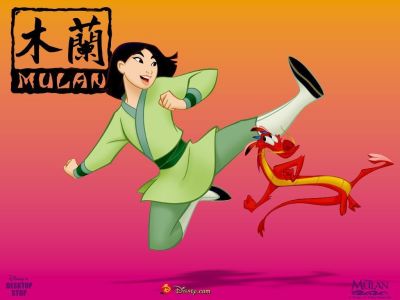
Mulan has always been one of my favorite Disney movies. From the wonderful song of "I'll Make a Man out of You" to the breaking of gender norms, these all contribute to the greatness that this movie possesses. The Disney movie, Mulan, is based on the Chinese folklore Fa Mu Lan. Although there are some differing points, such as how Mulan fights the Hun while Fa Mu Lan fights the greedy "baron [when] he was counting his money, his fat ringed fingers playing over the abacus" (Kingston 43). However the overlying concept is the same, women can be more than just wives of slaves, or as Kingston would say "maggots in the rice" (43).  As a kid, I always loved movies where the good guy defeated the bad guys and saved the day (pretty much every children's movie). This Disney movie was one of the first Disney movies that portrayed a female who did not seek the help of a male character, but, as expected, there still is romance in the movie. However, unlike the princess movies that preceded it, Mulan did not change herself in order to receive the affection of some silly boy. Instead, she earns his affection through her quick wits, creative thinking, hard working attitude, and courage. Another thing that I like about the movie is that not only does it show women as capable of being a woman warrior, but it also shows that men don't always have to act so masculine. There is a scene where Yao, Ling, and Chien-Po dress as women in order to seduce the Hun guards. This is a true example of Hook's definition of feminism, eliminating all forms of sexism in society.In my opinion, Mulan is, and always will be, one of the best Disney movies ever created and hopefully has inspired people to stand up against gender stereotypes as well as support feminism.


Because the only other one that even comes close is The Lion King, and I'll still fight you on that.


Music Video of "I'll Make A Man Out Of You"
https://www.youtube.com/watch?v=Fqta4jyAs4k

Sunday, October 4, 2015

Are We Self-centered?

Why is it that the things that should be the most obvious to us are the hardest to understand? It is astounding how oblivious most of us, myself included, are to our surroundings. Why do we never care about things that don't concern us? David Foster Wallace said, "Think about it: There is no experience you've had that you were not at the absolute center of" (233). Personally, it is very hard for me to think of a memory that doesn't involve me in any way. To some, that might make me appear self-centered, but let's be honest here, who isn't self-centered? Now, I don't mean that in the negative way it is more commonly used nowadays, but it is true that everybody does things for themselves. Since childhood, we are told to live our lives for ourselves. However, even though we are all self-centered, that doesn't mean we should never take into account how other people feel. For example, in school, like most students, I often complain about the vast amount of work that teachers assign for homework. Until I read the piece "This is Water", by David Foster Wallace, I never even considered that these teachers have taught their respective classes years before I even walked into Troy High, and that maybe over the years they have fine-tuned their classes to give just the right amount of work to help us students succeed. Hopefully in the future, I will try harder to refrain from automatically assuming that my life and problems are more important than anybody else's. Wallace has shown me that although I am a self-centered person, it isn't necessarily a bad thing. He has also helped me to develop tremendous respect to those around me who also face unspoken problems each and every day. A Facebook page that has also put this into perspective is, "Humans of New York". The page consists of pictures of random people and their stories. It shows that each and every single person has had to deal with problems, so it isn't fair to judge others.
                             
              Image result for humans of new york

Sunday, September 27, 2015

Perspectives and Stereotyping

Perspectives are why people think so differently. They can help unite those with the same perspective and accomplish amazing things. However, they can also alienate anyone with an opposing view. For example, in Frederick Douglass's speech, he talks about the Fourth of July from the African-American point of view, and says "I am not included within the pale of glorious anniversary" (Douglas). He claims that African Americas do not see the fourth of July the way that white people do. This is not the only example. It can be seen with the rich and the poor, jocks and nerds, thrill-seekers and worrywarts, etc. The list goes on and on. People often times have different perspectives on a wide variety of topics and can't understand why the other group does what they do.


 My life composes of a mix between a rigorous workload from school and hours upon hours of swimming. There have been times when kids on my swim team ask why I take so many AP's and put in extra time to improve my standardized test scores, and there are also times when friends from school wonder why I spend so much time swimming up and down a pool staring at a black line. While this does show how people of tend to always look at things through their point of view while giving no thought as to the thoughts of the other group, it more importantly shows the negative boundaries of stereotyping. Take me for example, why does me being an athlete automatically make me somebody who doesn't care as much about grades or me being a studious kid automatically make me somebody who couldn't possibly enjoy participating in sports? People need to realize that boundaries between interests aren't black and white, and that these blurred lines between interests are what make us so unique.  


Sunday, September 20, 2015

Remembrance

People need to be remembered. It doesn't matter whether they did something important for the nation or whether they just made you laugh that one time when you were down. Every single person deserves to be remembered in some way. The easiest way to remember someone is through memories. Memories immortalize a person long after his or her body has perished. They enable a person to cling onto all that the person has done for them. Another way to remember people is through memorials. Memorials are a common way to acknowledge people that did something important. However, most people don't realize how sentimental memorials actually are. They go much deeper than just the surface; the location, symbols, design, etc all represent something that is significant to the death of those that are memorialized. Other things such as everyday objects, pictures, people, aromas, etc are all ways to remember people. This can be connected to a theme in The Things They Carried. In the novel, O'Brien believes that the emotions that war causes need to be remembered. A theme in this novel is that it doesn't matter whether the story is true or not, as long as the emotions are the same, the people will be remembered. The theme further exemplifies a way to remember: through emotions. O'Brien makes the reader feel all the emotions that soldiers feel when they go to war, and in turn, it makes it so that there is a connection between the soldier, real or not, and the reader. The USS Arizona memorial in an example of remembrance. Even though the Pearl Harbor attack occurred decades ago, the memorial still stands to honor those that died. The USS Arizona, like many other memorials, has many subtle attributes that exhibit little tidbits of why they should be remembered. For example, the design of the USS Arizona shows the weakening of the United States after the attack, but it also shows how they rebounded and regained prominence again. Also, the people that are remembered are associated with why the United States entered World War II. Remembering is so important because it allows the legacy that people left to be carried on by others.


Image result for uss arizona memorial