
Sunday, October 25, 2015
Inescapable Borders
In Maus, Spiegelman uses borders as a rhetorical strategy in order to reveal his message of the inevitable doom that families often faced. His uses borders as visual metaphors in order to emphasize that horror. The borders surrounding each panel show how people were trapped, and there was little they could do to successfully change their fate.. On page 74 in Maus I, all the panels except the last one have a border surrounding it. It represents how even though they are all together at the dinner table, they are all confined to their destinies: death. However, the last panel does not contain a border which shows that Herman and Hela were fortunate enough to escape death. Also in the first panel of the page, the windows are another way that borders are created. To the reader, it appears as if Vladek and his family are locked up behind jail bars, and it foreshadows their eventual placement into concentration camps. Spiegelman uses borders in his because he wants to give structure to his father's narrative as well as to show that the Holocaust was inescapable. However, borders, such as those in pictures, can sometimes be a good thing. Having something contained, such as memories, eternalizes those in it and what they have done. Creating pictures allows things to remain the same even if it will change in the future. The lack of change that the picture has allows for all the good in the picture to remain forever. This can be connected to when we discussed memorials and about Tim O'Briens belief in remembrance.


Sunday, October 18, 2015
Masks
Masks can be used to give false appearances, hide identities, and even allow one to act like someone they are not. Art Spiegelman uses masks in Maus and Maus II in order to use them as a symbol for something much deeper than the physical mask. In Maus, the masks are used in order to help the Jews, the mice, to act like the Poles, the pigs. By displaying each race as a different species, it helps to show that during the Holocaust there was a clear categorization of people. The Nazis, the cats, ruthlessly hunted the Jews, the mice, while the Poles, the pigs, did nearly nothing to stop them. On the panel below, Vladek puts on a pig mask and pretends to be a Pole in order to receive aid from Polish people.

However, in Maus II, the meaning of the mask changes. On page 41 of Maus II, it shows a human wearing a mouse mask. The flies around Art depict the mice, and in turn the Jews, as being vermin and weak. While Art doesn't necessarily believe this, the Nazis did, and that allowed for all Jews to be put under this mask. By being put under these masks, the Jews were more easily alienated. These masks allow the reader to relate to the emotions that the characters feel and understand just how easily it is to be placed under a mask. For example, if everybody starts to consider you the funny kid of the class, you are given that mask and are expected to fulfill its duties. Putting a mask on yourself and having a mask put on you are two very different things. One allows you to hide things that you don't want others to know while the other forces you into a group/category that you may not want to be in.

However, in Maus II, the meaning of the mask changes. On page 41 of Maus II, it shows a human wearing a mouse mask. The flies around Art depict the mice, and in turn the Jews, as being vermin and weak. While Art doesn't necessarily believe this, the Nazis did, and that allowed for all Jews to be put under this mask. By being put under these masks, the Jews were more easily alienated. These masks allow the reader to relate to the emotions that the characters feel and understand just how easily it is to be placed under a mask. For example, if everybody starts to consider you the funny kid of the class, you are given that mask and are expected to fulfill its duties. Putting a mask on yourself and having a mask put on you are two very different things. One allows you to hide things that you don't want others to know while the other forces you into a group/category that you may not want to be in.
Sunday, October 11, 2015
Mulan
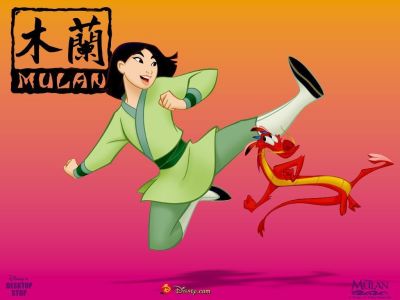
Mulan has always been one of my favorite Disney movies. From the wonderful song of "I'll Make a Man out of You" to the breaking of gender norms, these all contribute to the greatness that this movie possesses. The Disney movie, Mulan, is based on the Chinese folklore Fa Mu Lan. Although there are some differing points, such as how Mulan fights the Hun while Fa Mu Lan fights the greedy "baron [when] he was counting his money, his fat ringed fingers playing over the abacus" (Kingston 43). However the overlying concept is the same, women can be more than just wives of slaves, or as Kingston would say "maggots in the rice" (43). As a kid, I always loved movies where the good guy defeated the bad guys and saved the day (pretty much every children's movie). This Disney movie was one of the first Disney movies that portrayed a female who did not seek the help of a male character, but, as expected, there still is romance in the movie. However, unlike the princess movies that preceded it, Mulan did not change herself in order to receive the affection of some silly boy. Instead, she earns his affection through her quick wits, creative thinking, hard working attitude, and courage. Another thing that I like about the movie is that not only does it show women as capable of being a woman warrior, but it also shows that men don't always have to act so masculine. There is a scene where Yao, Ling, and Chien-Po dress as women in order to seduce the Hun guards. This is a true example of Hook's definition of feminism, eliminating all forms of sexism in society.In my opinion, Mulan is, and always will be, one of the best Disney movies ever created and hopefully has inspired people to stand up against gender stereotypes as well as support feminism.
Music Video of "I'll Make A Man Out Of You"
https://www.youtube.com/watch?v=Fqta4jyAs4k
Sunday, October 4, 2015
Are We Self-centered?
Why is it that the things that should be the most obvious to us are the hardest to understand? It is astounding how oblivious most of us, myself included, are to our surroundings. Why do we never care about things that don't concern us? David Foster Wallace said, "Think about it: There is no experience you've had that you were not at the absolute center of" (233). Personally, it is very hard for me to think of a memory that doesn't involve me in any way. To some, that might make me appear self-centered, but let's be honest here, who isn't self-centered? Now, I don't mean that in the negative way it is more commonly used nowadays, but it is true that everybody does things for themselves. Since childhood, we are told to live our lives for ourselves. However, even though we are all self-centered, that doesn't mean we should never take into account how other people feel. For example, in school, like most students, I often complain about the vast amount of work that teachers assign for homework. Until I read the piece "This is Water", by David Foster Wallace, I never even considered that these teachers have taught their respective classes years before I even walked into Troy High, and that maybe over the years they have fine-tuned their classes to give just the right amount of work to help us students succeed. Hopefully in the future, I will try harder to refrain from automatically assuming that my life and problems are more important than anybody else's. Wallace has shown me that although I am a self-centered person, it isn't necessarily a bad thing. He has also helped me to develop tremendous respect to those around me who also face unspoken problems each and every day. A Facebook page that has also put this into perspective is, "Humans of New York". The page consists of pictures of random people and their stories. It shows that each and every single person has had to deal with problems, so it isn't fair to judge others.


Subscribe to:
Posts (Atom)